
Why Your AI Outbound Stack Is Costing You 2–3x More Than It Should (And How to Fix It in 90 Days)
2026 Guide to Upgrading Your Sales Automation Without Ripping Everything Out

THE REAL COST OF STAYING PUT
Your Outreach Stack Isn’t Broken. It’s Just Bleeding You Dry.
I’ve audited the GTM stacks of more sales teams than I can count, and the pattern is almost always the same. They know the contract line for Outreach or SalesLoft. They don’t know the actual math.
A typical legacy stack runs $300–500 per user per month (that’s just the software). Then there’s the integration hell: hidden costs to make tools that weren’t designed to talk to each other actually work, custom consulting hours to keep it from breaking every quarter. If you have 8–15 SDRs, you’re probably spending $4,000–8,000/month on tooling alone, before accounting for the human hours filling the gaps.
But the real cost isn’t the tools. It’s what the tools don’t do.
Your SDRs spend only 25% of their working hours actually selling. The other 75%? Manual research. Data entry. Logging calls. Chasing down enrichment that should have been automatic.
With a legacy stack, an SDR runs 104 activities per day and lands a real conversation from maybe 18% of them. That is expensive guessing dressed up as a pipeline engine.
You can’t hire your way out of this problem. SDR turnover runs 30%+ industry-wide — some mid-market companies see 55%. Your reps stay 14–18 months on average. After a 3-month ramp, you’re getting barely a year of actual productivity before the replacement cycle begins.
Replace one SDR? $100K–$160K all-in (salary, benefits, stack costs, training, lost productivity). Do that twice a year on a team of six and you’re spending $200K–$320K just to maintain baseline.
Here’s what I see consistently: leaner, newer companies are running smaller outbound teams and generating more pipeline - because their people aren’t doing the data work. Your team is still staffing the workflow. You’re not losing on strategy. You’re losing on how much of your payroll actually touches a prospect.
Mid-market companies locked into legacy infrastructure have to hire 2–3x more headcount to generate the same pipeline volume as teams running modern AI outbound tools. You’re not overstaffed because your people are weak, rather because your tools are inefficient.
The cost of staying isn’t the monthly bill. It’s the headcount you can’t redeploy. It’s the velocity you’re losing because iteration takes months instead of weeks. It’s the talent you’re burning because nobody wants to spend their day logging calls.
If you’re still running manual list-building + a decade-old sequencer in 2026, your leaner competitors aren’t.
WHAT YOUR LEGACY STACK IS ACTUALLY DOING TO YOU
Built for a Different Era (Now It’s Quietly Throttling Your Growth)
The infrastructure you’ve got made sense when you built it. Maybe 2008 or 2015. At the time, it was the right call, and honestly, getting any repeatable process in place was an upgrade over the chaos that came before it. I’ve seen what pre-process outbound looks like. Your old stack was a genuine step forward.
The problem is what it can’t do now.
The typical mid-market setup: A CRM as your source of truth, Outreach or SalesLoft as your engagement layer, maybe Apollo or ZoomInfo for enrichment, and a lot of human labor gluing it all together. No workflow automation between tools. No AI prospecting layer. No intent signals. Just good people doing slow work.
It breaks for three specific reasons:
First: Research is a bottleneck. Someone manually hunts through LinkedIn, job boards, company websites, news. They stitch together what they can from Apollo or ZoomInfo. Fifteen to twenty minutes per prospect. Multiply that by 50–100 prospects per SDR per week. That’s 12–30 hours of pure research time — and you still end up with gaps. Missing job titles. Incomplete tech stack data. No signal about what’s actually happening at that account right now.
Second: There’s no outbound automation layer. Each step requires a human decision and manual input. Research done? Enrich manually. Enrichment complete? Write the message. Schedule follow-ups. Log it. Each handoff is a friction point. You can’t test a new ICP segment in a week. You can’t run a targeted campaign without a month of planning. Your velocity is capped by how fast humans can move data.
Third: Deliverability is a problem hiding in plain sight. Legacy stacks don’t come with native IP warm-up, DKIM/SPF/DMARC configuration, or domain rotation logic. Gmail placement dropped from 89.8% (early 2024) to 87.2% by Q4 as spam filters tightened. Weak authentication can cause an 80% delivery drop.
The deeper issue: these tools were built for control, not leverage. At 5 SDRs, fine. At 15, you’re choking. At 25, you’re hemorrhaging productivity and wondering why you need to keep hiring just to stay flat.
The teams that stay on legacy stacks assume the answer is “get better people.” The teams rebuilding with AI outbound automation assume the answer is “get better infrastructure.” Guess which one scales.
THE MODERN AI OUTBOUND STACK
What Actually Works — Without Ripping Everything Out
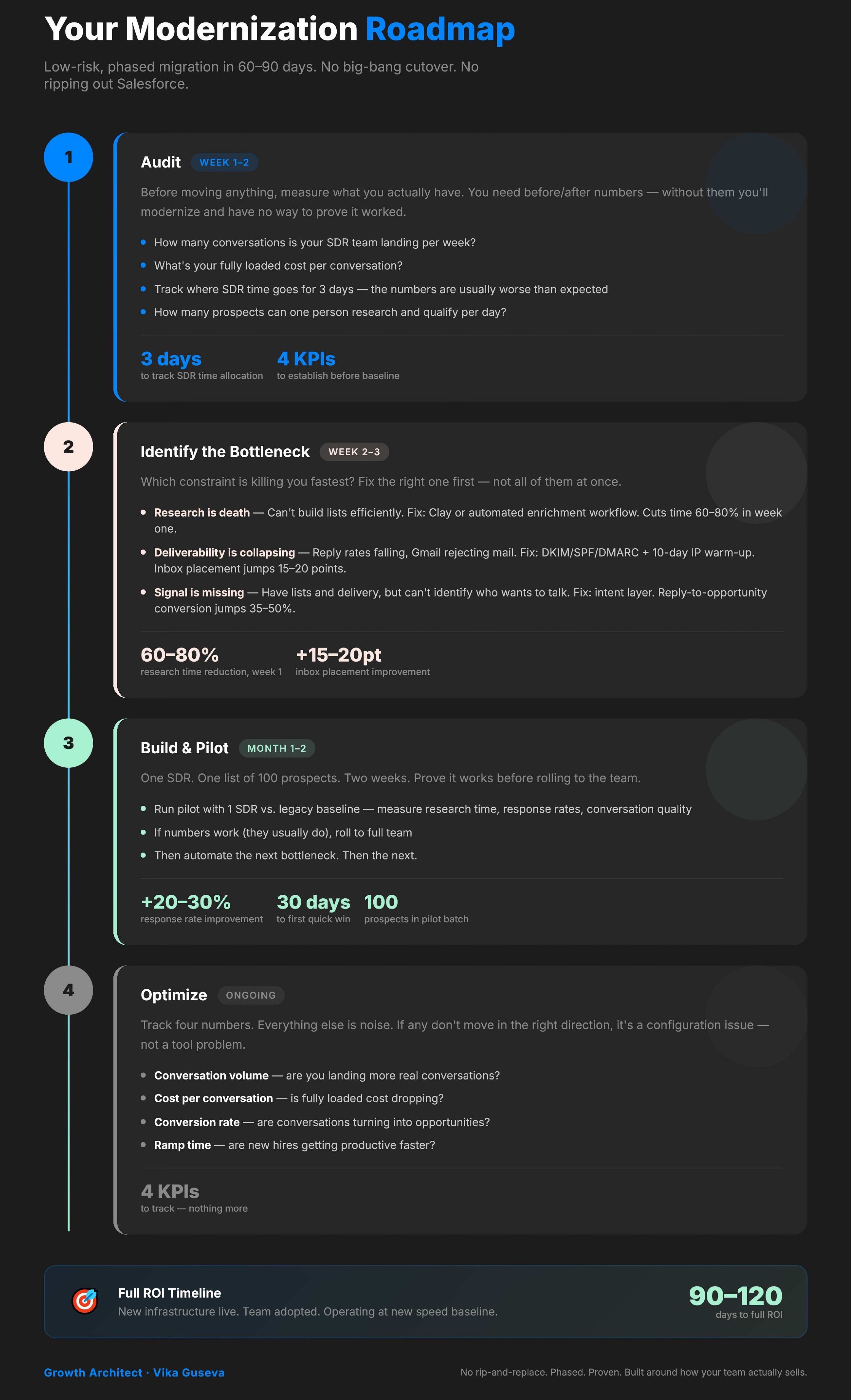
The modernized outreach setup isn’t about chasing AI hype. It’s about efficiency: tools that talk to each other, AI handling the grunt work, and your people doing the thinking. When I build these systems for mid-market teams, I think in four layers — each with one job.
Layer 1 — AI Prospecting + Enrichment: Tools like Clay, Apollo (upgraded tier), or Smartlead. The job isn’t “build a list faster.” It’s “reduce human research time from 20 minutes per prospect to 2 minutes.” You define the criteria — title, company size, tech stack, buying signals — and the system returns verified matches with context. Not a list. A qualified hypothesis about where your buyer actually is.
This is where AI prospecting automation does its heaviest lifting. Instead of an SDR manually hunting for 20 minutes, a custom workflow pulls, enriches, and scores each prospect before a human ever touches it. I build these as tailored Clay or n8n workflows — configured to your ICP, your signals, your CRM. Not off-the-shelf. Built for how you actually sell.
Real numbers: teams using modern AI research tools report 40–60% reduction in research time per prospect. That frees up 10–15 hours per SDR per week.
Layer 2 — Delivery + Inbox Reliability: Instantly, Lemlist, or your existing sequencer upgraded with proper authentication and warm-up. The job is getting emails into the inbox reliably — not just sending them. Modern tools handle DKIM/SPF/DMARC setup, domain rotation, and IP warm-up so your reply rates don’t crater. Legacy tools leave this to chance.
Modern AI outbound infrastructure maintains 87–90% inbox placement. That’s 12–15 percentage points better than an unmanaged legacy setup — before you change a single word of your messaging.
